Thursday, 4 August 2016

Wife-Beating in ISLAM

What Does Islam Teach About...Wife-Beating

Does Islam allow a man to hit his wife? 

Yes, but only if she doesn't do as he asks. The beating must stop if the woman complies with her husband's demands. Behind verbal abuse and abandonment, beating is intended as last resort solution to coerce submission.

According her testimony in the Hadith, Muhammad physically struck his favorite wife for leaving the house without his permission. It is not known how he treated his less-favored wives.

Quran

Quran (4:34) - "Men are the maintainers of women because Allah has made some of them to excel others and because they spend out of their property; the good women are therefore obedient, guarding the unseen as Allah has guarded; and (as to) those on whose part you fear desertion, admonish them, and leave them alone in the sleeping-places and beat them; then if they obey you, do not seek a way against them; surely Allah is High, Great."  Contemporary translations sometimes water down the word 'beat', but it is the same one used in verse 8:12 and clearly means 'to strike'.
Quran (38:44) - "And take in your hand a green branch and beat her with it, and do not break your oath..."  Allah telling Job to beat his wife (Tafsir).

Hadith and Sira

Bukhari (72:715) - A woman came to Muhammad and begged her to stop her husband from beating her. Her skin was bruised so badly that it is described as being "greener" than the green veil she was wearing. Muhammad did not admonish her husband, but instead ordered her to return to him and submit to his sexual desires.

Bukhari (72:715) - "Aisha said, 'I have not seen any woman suffering as much as the believing women'" Muhammad's own wife complained of the abuse that the women of her religion suffered relative to other women. 

Muslim (4:2127) - Muhammad struck his favorite wife, Aisha, in the chest one evening when she left the house without his permission. Aisha narrates, "He struck me on the chest which caused me pain."

Muslim (9:3506) - Muhammad's fathers-in-law (Abu Bakr and Umar) amused him by slapping his wives (Aisha and Hafsa) for annoying him. According to the Hadith, the prophet of Islam laughed upon hearing this.

Abu Dawud (2141) - "Iyas bin ‘Abd Allah bin Abi Dhubab reported the Apostle of Allah (may peace be upon him) as saying: Do not beat Allah’s handmaidens, but when ‘Umar came to the Apostle of Allah (may peace be upon him) and said: Women have become emboldened towards their husbands, he (the Prophet) gave permission to beat them." At first, Muhammad forbade men from beating their wives, but he rescinded this once it was reported that women were becoming emboldened toward their husbands. Beatings in a Muslim marriage are sometimes necessary to keep women in their place.

Abu Dawud (2142) - "The Prophet (peace be upon him) said: A man will not be asked as to why he beat his wife." 

Abu Dawud (2126) - "A man from the Ansar called Basrah said: 'I married a virgin woman in her veil. When I entered upon her, I found her pregnant. (I mentioned this to the Prophet).' The Prophet (peace_be_upon_him) said: 'She will get the dower, for you made her vagina lawful for you. The child will be your slave. When she has begotten (a child), flog her'" A Muslim thinks he is getting a virgin, then finds out that she is pregnant. Muhammad tells him to treat the woman as a sex slave and then flog her after she delivers the child.

Ibn Ishaq/Hisham 969 - Requires that a married woman be "put in a separate room and beaten lightly" if she "act in a sexual manner toward others." According to the Hadith, this can be for an offense as petty as merely being alone with a man to whom she is not related.

Kash-shaf (the revealer) of al-Zamkhshari (Vol. 1, p. 525) - [Muhammad said] "Hang up your scourge where your wife can see it"

Notes

Some contemporary Muslim apologists often squirm over this relatively straightforward verse from the Quran (4:34) - which gives men the right to beat their wives if they even have a "fear" of disloyalty or disobedience.  Their rhetorical aerobics inspired us to write a separate article: 


Others are not nearly as squeamish.  Sheikh Yousef al-Qaradhawi, one of the most respected Muslim clerics in the world, once made the famous (and somewhat ridiculous statement) that "It is forbidden to beat the woman, unless it is necessary."  He went on to say that "one may beat only to safeguard Islamic behavior," leaving no doubt that wife-beating is a matter of religious sanction.  (source)

Dr. Muzammil Saddiqi, the former president of ISNA (the Islamic Society of North America), a mainstream Muslim organization, says it is important that a wife "recognizes the authority of her husband in the house" and that he may use physical force if he is "sure it would improve the situation."  (source)

Sheikh Dr. Ahmad Muhammad Ahmad Al-Tayyeb, the head of Al-Azhar, Sunni Islam's most prestigious institution says that "light beatings" and "punching" are part of a program to "reformthe wife" (source).  

Dr. Jamal Badawi endorses corporal punishment as "another measure that may save the marriage" (source).   He isn't clear on how striking a woman will make her more inclined toward staying with her assailant, unless the implication is fear of more serious consequences if she leaves. 

Egyptian cleric, Abd al-Rahman Mansour, said in a 2012 televised broadcast that, in addition to discouraging the wife from filing divorce, beatings would inspire the wife to "treat him with kindness and respect, and know that her husband has a higher status than her." (source)

During Ramadan of 2010, another cleric named Sa'd Arafat actually said the woman is "honored" by the beating (source).  No one else seemed terribly surprised or upset by this.

An undercover report from progressive Sweden in 2012 found that 60% of mosques there actually advised beaten women not to report the abuse to the police.  These women were also told that they must submit to non-consensual 'sex' with their husbands.  (source)

In the birthplace of Islam, about half of Saudi women are beaten at home.  "Hands and sticks were found to be used mostly in beating women, following by men’s head cover and to a lesser extent, sharp objects." (source)

In 2016, the Council of Islamic Ideology proposed a bill - ironically named the Protection of Women against Violence Act - that actually included exceptions for "lightly beating" defiant wives.  (source) 

According to Islamic law, a husband may strike his wife for any one of the following four reasons:
- She does not attempt to make herself beautiful for him (ie. "let's herself go")
- She refuses to meet his sexual demands
- She leaves the house without his permission or for a "legitimate reason"
- She neglects her religious duties
Any of these are also sufficient grounds for divorce.

Respected Quran scholars in the past interpreted verse 4:34 with impressive candor.  Tabari said that it means to "admonish them, but if they refused to repent, then tie them up in their homes and beat them until they obey Allah’s commands toward you."  Qurtubi told wife-beaters to avoid breaking bones, if possible, but added that "it is not a crime if it leads to death." (source)

Muslim apologists sometimes say that Muhammad ordered that women not be harmed, but they are actually basing this on what he said before or during a battle, such as in Bukhari (59:447), when Muhammad issued a command for all the men of Quraiza be killed and the women and children taken as slaves.  (Having your husband murdered and being forced into sexual slavery apparently doesn't qualify as "harm" under the Islamic model).

But, in fact, there are a number of cases in which Muhammad did have women killed in the most brutal fashion.  One was Asma bint Marwan, a mother or five, who wrote a poem criticizing the Medinans for accepting Muhammad after he had ordered the murder of an elderly man.  In this case, the prophet's assassins literally pulled a sleeping infant from her breast and stabbed her to death.

After taking Mecca in 630, Muhammad also ordered the murder of a slave girl who had merely made up songs mocking him.  The Hadith are rife with accounts of women planted in the ground on Muhammad's command and pelted to death with stones for sexual immorality - yet the prophet of Islam actually encouraged his own men to rape women captured in battle (Abu Dawood 2150, Muslim 3433) and did not punish them for killing non-Muslim women (as Khalid ibn Walid did on several occasions - see Ibn Ishaq 838 and 856).

In summary, according to the Qur'an, Hadith and Islamic law, a woman may indeed have physical harm done to her if the circumstances warrant, with one such allowance being in the case of disobedience.  This certainly does not mean that all Muslim men beat their wives, only that Islam permits them to do so.


#Faishal Ahmed (ex-muslim)


Why are rape victims often punished by Islamic courts as adulterers?

 What Does Islam Teach About Rape and Adultery?
Why are rape victims often punished by Islamic courts as adulterers?  

Under Islamic law, rape can only be proven if the rapist confesses or if there are four male witnesses.  Women who allege rape without the benefit of the act having been witnessed by four men (who presumably develop a conscience afterwards) are actually confessing to having sex.  If they or the accused happens to be married, then it is considered to be adultery.

Quran

Quran (2:282) - Establishes that a woman's testimony is worth only half that of a man's in court (there is no "he said/she said" gridlock in Islam).

Quran (24:4) - "And those who accuse free women then do not bring four witnesses (to adultery), flog them..."  Strictly speaking, this verse addresses adultery (revealed at the very time that Muhammad's favorite wife was being accused of adultery on the basis of only three witnesses coincidentally enough).  However it is a part of the theological underpinning of the Sharia rule on rape, since if there are not four male witnesses, the rape "did not occur".

Quran (24:13) - "Why did they not bring four witnesses of it? But as they have not brought witnesses they are liars before Allah."

Quran (2:223) - "Your wives are as a tilth unto you; so approach your tilth when or how ye will..."  There is no such thing as rape in marriage, as a man is permitted unrestricted sexual access to his wives.

Hadith and Sira

Bukhari (5:59:462)  - The background for the Quranic requirement of four witnesses to adultery.  Muhammad's favorite wife, Aisha, was accused of cheating [on her polygamous husband].  Three witnesses corroborated the event, but Muhammad apparently did not want to believe it, and so established the arbitrary rule that four witnesses are required.
Notes

Rape of Muslim women is against Islamic law - although the rape of non-Muslim women is not, if they are 'captured in battle' or bought as slaves.  Even the rape of a Muslim woman is almost impossible to prove under strict Islamic law (Sharia).  If the man claims that the act was consensual sex, there is very little that the woman can do to refute this.  Islam places the burden of avoiding sexual encounters of any sort on the woman.

A recent fatwa from a mainstream Islamic site echoes this rule and even chides a victim of incest for complaining when she has no "evidence":
However, it is not permissible to accuse the father of rape without evidence. Indeed, the Sharee’ah put some special conditions for proving Zina (fornication or adultery) that are not required in case of other crimes. The crime of Zina is not confirmed except if the fornicator admits it, or with the testimony of four trustworthy men, while the testimony of women is not accepted. 
Hence, the statement of this girl or the statement of her mother in itself does not Islamically prove anything against the father, especially that the latter denies it. 
Therefore, if this daughter has no evidence to prove that her accusations are true, she should not have claimed that she was raped by her father and she should not have taken him to the court. (IslamWeb.net, Image)

Since it is incredibly unlikely that a child molester will violate his victim in front of "four trustworthy men", Islamic law amounts to a free pass for sexual predators.

Islamic law rejects forensic evidence (such as DNA) in favor of testimony.  An interesting situation thus sometimes develops in cases where a victim alleges rape and the man denies that sex even took place.  In the absence of four male witnesses, rape cannot be proven.  The woman's testimony then becomes a "confession" of adultery.  She can be stoned, even though the male is unpunished, since he never admitted to a sexual act.

Some clerics blame rape on the woman.  Australian Sheik Feiz recently  said a rape victim "has no one to blame but herself.  She displayed her beauty to the entire world... to tease man and appeal to his carnal nature."  Even his successor, who was brought in to mitigate the backlash,  compared unveiled women to "sweet pastries" tempting hungry men.

One of the world's most respected Sunni scholars, Sheikh Yusuf al-Qaradawi, recently  told an audience on his al-Jazeera television show that "To be absolved from guilt, the raped woman must have shown some sort of good conduct."

Dr. Abd al-Aziz Fawazan al-Fawzan, a professor of Islamic law said that "If a woman gets raped walking in public alone, then she, herself is at fault. She is only seducing men by her presence. She should have stayed at home like a Muslim woman."  

This was echoed by the imam of a Salafist mosque in Cologne, Germany in the wake of the shocking sex abuse rampage by recently arrived Muslims on New Year's Eve in 2015.  He explained  that "the events" (which included rape) "were the girls' own fault because they were half-naked and wearing perfume." 

When it came to light in 2016 that a 13-year-old British girl had been abused by a dozen Pakistani rapists, certain members of the Muslim community said  they believed the victim "played her part."

In 2013, Syria's chief Mufti, Sheikh Abd al-Rahman Ali al-Dala, issued  a statement that gives soldiers religious permission to rape the women they capture.

There can be also no such thing as rape in a Muslim marriage, even if the husband has to hit the wife in order to bring about her submission.  Another recent fatwa reminds a woman, she "does not have the right to refuse her husband, rather she must respond to his request every time he calls her." (Islam Q&A, Fatwa No.  33597).

Keep in mind that most Muslim countries do not operate under strict Islamic law, but rather under legal codes copied from the West.  Therefore rape victims in these countries can - and often do - receive justice under more reasonable standards of proof.

#Faishal Ahmed (ex-muslim)

Myths:Muhammad Would Never Approve of Rape?


Myths of Muhammad

The Myth:

Muhammad Would Never Approve of Rape?

"Our Prophet (peace be upon him) always held women in the deepest respect." 

The Truth:

It is against Islam to rape Muslim women, but Muhammad actually encouraged the rape of others captured in battle. This hadith provides the context for the Qur’anic verse (4:24):
The Apostle of Allah (may peace be upon him) sent a military expedition to Awtas on the occasion of the battle of Hunain.  They met their enemy and fought with them.  They defeated them and took them captives. Some of the Companions of the Apostle of Allah (may peace be upon him) were reluctant to have intercourse with the female captives in the presence of their husbands who were unbelievers.  So Allah, the Exalted, sent down the Qur’anic verse: (Sura 4:24) "And all married women (are forbidden) unto you save those (captives) whom your right hands possess." (Abu Dawud 2150, also Muslim 3433)
Actually, as the hadith indicates, it wasn't Muhammad, but "Allah the Exalted" who told the men to rape the women in front of their husbands - which is all the more reason to think of Islam differently from other religions.

Note also that the husbands of these unfortunate victims were obviously alive after battle.  This is important because it flatly contradicts those apologists who like to argue that the women Muhammad enslaved were widowed and thus unable to fend for themselves.  (Even if the apologists were right, what sort of a moral code is it that forces a widow to choose between being raped and starving?) 

There are several other episodes in which Muhammad is offered the clear opportunity to disavow raping women - yet he instead offers advice on how to proceed.  In one case, his men were reluctant to devalue their new slaves for later resale by getting them pregnant.  Muhammad was asked about coitus interruptus in particular:

"O Allah's Apostle! We get female captives as our share of booty, and we are interested in their prices, what is your opinion about coitus interruptus?"  The Prophet said, "Do you really do that? It is better for you not to do it. No soul that which Allah has destined to exist, but will surely come into existence.” (Bukhari 34:432)
http://www.usc.edu/org/cmje/religious-texts/hadith/bukhari/034-sbt.php#003.034.432


As indicated, the prophet of Islam did not mind his men raping the women, provided they ejaculated within the bodies of their victims.

As one might imagine, Muhammad's obvious approval of raping women captured in battle and his own personal participation as recorded in many places is of intense inconvenience to the Muslim apologists of our time.  For this reason, some of them attempt to explain away these many episodes and Qur'anic references to sex with captives by pretending that these are cases in which women have fled bad marriages and sought refuge with the Muslims.  Some apologists even refer to them as "wives," even though the Qur'an makes a clear distinction between "those whom thy right hand possesses" and true wives (see Sura 33:50).
https://www.thereligionofpeace.com/quran/noble/sura33.html#50


Beyond the desperation of the 21st century apologist however, there is absolutely nothing in the historical text that supports this rosy revision of Muslim history.  The women of the Banu Mustaliq were sold into slavery following their rape:

"We went out with Allah's Messenger (may peace be upon him) on the expedition to the Bi'l-Mustaliq and took captive some excellent Arab women; and we desired them, for we were suffering from the absence of our wives, (but at the same time) we also desired ransom for them. So we decided to have sexual intercourse with them but by observing 'azl (Withdrawing the male sexual organ before emission of semen to avoid-conception). But we said: We are doing an act whereas Allah's Messenger is amongst us; why not ask him? So we asked Allah's Messenger (may peace be upon him), and he said: It does not matter" (Sahih Muslim 3371)
http://www.usc.edu/org/cmje/religious-texts/hadith/muslim/008-smt.php#008.3371

In fact, female slaves were traded like any other simple commodity by Muhammad and his band of devoted followers:
"Then the apostle sent Sa-d b. Zayd al-Ansari, brother of Abdu'l-Ashal with some of the captive women of Banu Qurayza to Najd and he sold them for horses and weapons." (Ibn Ishaq/Hisham/Hisham 693)

Is it Islamic to sell one's wife for horses?  Clearly these were not wives!

More importantly, by definition a "captured" woman is not one who is fleeing her husband.  She is fleeing her captor (ie. the Muslim slave raider).  This hadith describes a typical raid, in which the women and children are captured as they are attempting to flee the attacking Muslims:

“…and then we attacked from all sides and reached their watering-place where a battle was fought.  Some of the enemies were killed and some were taken prisoners.  I saw a group of persons that consisted of women and children [escaping in the distance].  I was afraid lest they should reach the mountain before me, so I shot an arrow between them and the mountain.  When they saw the arrow, they stopped.  So I brought them, driving them along” (Sahih Muslim 4345)
http://www.usc.edu/org/cmje/religious-texts/hadith/muslim/019-smt.php#019.4345

The Muslim narrator sees the women trying to escape (following the massacre of their men) and cuts off their route by shooting an arrow into their path.  These aren't women trying to seek refuge with the Muslims.  They are trying to avoid capture by the Muslims.

The same hadith goes on to recount that Muhammad personally demanded one of the captured women for his own use:

I drove them along until I brought them to Abu Bakr who bestowed that girl upon me as a prize.  So we arrived in Medina.  I had not yet disrobed her when the Messenger of Allah (may peace be upon him) met me in the street and said: “Give me that girl.” (Sahih Muslim 4345)
The prophet of Islam and his companions used war to collect women for personal sexual use and for trading.  Unless she was arbitrarily declared as someone's wife, the woman became a sex slave.  In no case was her fate tied to anything that she had personally done, nor was she given a choice about her future. 

Now Further Reading From Quran And Hadees
http://leftislam1.blogspot.in/2016/08/rape-in-quran.html

#Faishal Ahmed

Part-1:Myths-Islam Respects Women as Equals?


The Myth:

The Quran places men and women on equal foundation before Allah and each other.
Women have equal rights under Islamic law. 

The Truth:

The Quran says that men and women will be judged by Allah.  This does not mean that they have equal rights and roles, or that they are judged by the same standards.

The Quran gives Muslim men permission to beat their wives for disobedience, but nowhere does it order love in marriage (although it does say that "love" exists).  The verses plainly say that husbands are “a degree above” their wives.  The Hadith says that women are intellectually inferior, and that they comprise the majority of Hell’s occupants.

Under Islamic law, a man may divorce his wife at his choosing.  If he does this twice, then wishes to remarry her, she must first have sex with another man.  Men are exempt from such degradation.

Muslim women are not free to marry whom they please as Muslim men are.  Their husband may also bring other wives (and slaves) into the marriage bed.  And she must be sexually available to him at any time (as a field ready to be “tilled,” according to the holy book of Islam).

Neither do Muslim women inherit property in equal portion to males.  This is somewhat ironic given that Islam owes its existence to the wealth of Muhammad's first wife, which would not otherwise have been inherited by her given that she had two brothers and her first husband had three sons.

A woman's testimony in court is considered to be worth only half that of a man’s, according to the Quran.  Unlike a man, she must also cover her head - and often her face.

If a woman wants to prove that she was raped, then there must be four male witnesses to corroborate her account (according to strict Sharia).  Otherwise she can be jailed or stoned to death for confessing to “adultery.”

Given all of this, it is quite a stretch to say that men and women have “equality under Islam” based on obscure theological analogies or comparisons.  This is an entirely new ploy designed for modern tastes, and it disagrees sharply with the reality of Islamic law and history.

#1 What Does Islam Teach About...Veils and Covering

Does Islam require women to cover themselves? 

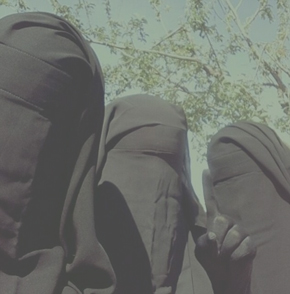
Yes. There is some disagreement as to whether the face should be veiled, but almost all scholars agree that a woman's hair should be covered. The covering of cloth is supposed to keep the sexual appetites of passing men at bay when women travel outside the home. This might even save a woman's life, since she is usually assumed to bear the responsibility of unlawful sexual encounters and thus subject to stoning.

Quran

Quran (33:59) - "Tell thy wives and thy daughters and the women of the believers to draw their cloaks close round them..."
Quran (24:31) - "And say to the believing women that they cast down their looks and guard their private parts and do not display their ornaments except what appears thereof, and let them wear their head-coverings over their bosoms, and not display their ornaments except to their husbands or their fathers, or the fathers of their husbands, or their sons, or the sons of their husbands, or their brothers, or their brothers' sons, or their sisters' sons, or their women, or those whom their right hands possess, or the male servants not having need (of women), or the children who have not attained knowledge of what is hidden of women; and let them not strike their feet so that what they hide of their ornaments may be known." The woman is not only supposed to cover herself, except with relatives, but to look down, so as to avoid making eye-contact with men.

Quran (33:55) - "It shall be no crime in them as to their fathers, or their sons, or their brothers, or their brothers’ sons, or their sisters’ sons, or their woman, or the slaves which their right hands possess, if they speak to them unveiled" A woman may present herself without a veil only to family and slaves.

Hadith and Sira

Sahih Bukhari (6:321) - Muhammad is asked whether it is right for a young woman to leave her house without a veil. He replies, "She should cover herself with the veil of her companion."
http://www.usc.edu/org/cmje/religious-texts/hadith/bukhari/006-sbt.php#001.006.321 

Sahih Bukhari (60:282) - After Muhammad issued the command (Quran 24:31) for women to cover themselves, the women responded by tearing up sheets to cover their faces.
Abu Dawud (32:4092) - The Apostle of Allah... said: "O Asma', when a woman reaches the age of menstruation, it does not suit her that she displays her parts of body except this and this, and he pointed to her face and hands" This was narrated by Aisha.
Abu Dawud (2:641) - The Prophet (peace_be_upon_him) said: Allah does not accept the prayer of a woman who has reached puberty unless she wears a veil. 
Sahih Bukhari (52:250) - [The Prophet said] "It is not permissible for a man to be alone with a woman, and no lady should travel except with a Muhram (i.e. her husband or a person whom she cannot marry in any case for ever; e.g. her father, brother, etc.)." - Neither is a woman allowed to travel by herself.
Sahih Bukhari (8:395): Narrated Umar: "My Lord agreed with me in three things: -1. I said, "O Allah's Messenger, I wish we took the station of Abraham as our praying place (for some of our prayers). So came the Divine Inspiration: And take you (people) the station of Abraham as a place of prayer (for some of your prayers e.g. two rak`at of Tawaf of Ka`ba)". (2.125) -2. And as regards the (verse of) the veiling of the women, I said, 'O Allah's Messenger! I wish you ordered your wives to cover themselves from the men because good and bad ones talk to them.' So the verse of the veiling of the women was revealed. -3. Once the wives of the Prophet made a united front against the Prophet and I said to them, 'It may be if he (the Prophet) divorced you, (all) that his Lord (Allah) will give him instead of you wives better than you.' So this verse (the same as I had said) was revealed." An interesting hadith reveals that Umar was the source of the verse on veils and that "Allah" followed with a concurring verse.  Early Muslims were not known for their skepticism.
Notes-

Islamic law (Sharia) requires women to cover themselves. The practical application in modern Muslim countries varies with a combination of individual and social taste. The Taliban require full burqas (covering everything, including a mesh for the eyes), while the more secular governments of Turkey and Tunisia once banned headscarves in public buildings (the bans have since been lifted following the Islamist ascension).

The head covering is interpreted as a symbol of male domination by most critics and by many Muslim women, who fight for the right to dress as they please.  A 21-year-old named Katia Bengana became the first casualty of the renewed Islamist terror campaign in Algeria after refusing to cover her hair.  She defended her choice even while the gun was pointed at her head.
http://www.chouf-chouf.com/actualites/societe/il-y-a-21-ans-katia-bengana-a-ete-assassinee-pour-avoir-refuse-de-porter-le-hijab/

Some apologists insist that the veil is not mandated by the religion, although they do not have anything within the sacred texts to counter the passages in which Muhammad instructed its use. In fact, verse 24:60 says that the veil is optional only for unmarried women too old to have children. 
CAIR's Jamal Badawi, often held up as a moderate scholar, insists that the hijab is "a command of Allah to Muslim women" and it should be "the duty of the state" to enforce it.

Some women do wear the hijab by choice, but it is impossible to say what percentage, since the pressure to cover one's head can either be subtle or pronounced. In 2011, an imam at a supposedly moderate mosque in Sammamish, Washington claimed that Muslim wives wear the hijab because they want to, but then stated that they may be "punished" if they refuse. In Pakistan, uncovered women are routinely attacked with acid. In Iran, Basij fundamentalists have raped and killed dress code violators.
Clerics, such as Sheik Taj Din al-Hilali, have said that unveiled victims of public rape invited their attackers: "If I came across a rape crime – kidnap and violation of honour – I would discipline the man and order that the woman be arrested and jailed for life.' Why would you do this, Rafihi? He says because if she had not left the meat uncovered, the cat wouldn't have snatched it... If you take uncovered meat and put it on the street, on the pavement, in a garden, in a park or in the backyard, without a cover and the cats eat it, is it the fault of the cat or the uncovered meat? The uncovered meat is the problem."
In responding to a 2014 anti-hijab demonstration by women, an Iranian activist bluntly said that "it is a man's right to benefit from what he loves. When a man forces himself onto a woman because she is "showing off her beauty", this [should not] be considered rape." 
In keeping with this theme, Muslim rapists in the West have been known to credit their motivation to the victim's choice of dress (one such example being from Australia in 2011). It is somewhat obvious that many women rely on the veil for for protection against unwanted male attention. Even non-Muslim residents and Western visitors to the Islamic world often find it necessary to cover themselves so as to avoid the harassment of Muslim men on the street. 
In 2014, a cleric suggested that babies be put into burqas to protect them against molestation. (Condemning the child molesters did eventually occur to him as an afterthought).
Veils and burqas are becoming more common in Muslim countries with the resurgence of Islamic fundamentalism. In the West, they are gradually becoming a chic statement of political protest or a symbol of religious distinction. 

Palestinian suicide bomber, Zeynab Abu Salam... 
she knew how to keep a tight hijab.

#2 What Does Islam Teach About... A Woman's Worth


Does Islam teach that a woman is worth less than a man? 

Absolutely. The only debatable point is by what degree.

Quran

Quran (4:11) - (Inheritance) "The male shall have the equal of the portion of two females" (see also verse 4:176). In Islam, sexism is mathematically established.
Quran (2:282) - (Court testimony) "And call to witness, from among your men, two witnesses. And if two men be not found then a man and two women." Muslim apologists offer creative explanations to explain why Allah felt that a man's testimony in court should be valued twice as highly as a woman's, but studies consistently show that women are actually less likely to tell lies than men, meaning that they make more reliable witnesses.

Quran (2:228) - "and the men are a degree above them [women]"

Quran (5:6) - "And if ye are unclean, purify yourselves. And if ye are sick or on a journey, or one of you cometh from the closet, or ye have had contact with women, and ye find not water, then go to clean, high ground and rub your faces and your hands with some of it" Men are to rub dirt on their hands, if there is no water to purify them, following casual contact with a woman (such as shaking hands).

Quran (24:31) - Women are to lower their gaze around men, so they do not look them in the eye.
(To be fair, men are told to do the same thing in the prior verse).

Quran (2:223) - "Your wives are as a tilth unto you; so approach your tilth when or how ye will..."
A man has dominion over his wives' bodies as he does his land. This verse is overtly sexual. There is some dispute as to whether it is referring to the practice of anal intercourse. If this is what Muhammad meant, then it would appear to contradict what he said in Muslim (8:3365).

Quran (4:3) - (Wife-to-husband ratio) "Marry women of your choice, Two or three or four" Inequality by numbers.

Quran (53:27) - "Those who believe not in the Hereafter, name the angels with female names." Angels are sublime beings, and would therefore be male.

Quran (4:24) and Quran (33:50) - A man is permitted to take women as sex slaves outside of marriage. Note that the verse distinguishes wives from captives (those whom they right hand possesses).

Hadith and Sira

Bukhari (6:301) - "[Muhammad] said, 'Is not the evidence of two women equal to the witness of one man?' They replied in the affirmative. He said, 'This is the deficiency in her intelligence.'"
Bukhari (6:301) - continued - "[Muhammad said] 'Isn't it true that a woman can neither pray nor fast during her menses?' The women replied in the affirmative. He said, 'This is the deficiency in her religion.'" Allah has made women deficient in the practice of their religion as well, by giving them menstrual cycles. 
Bukhari (2:29) - Women comprise the majority of Hell's occupants. This is important because the only women in heaven mentioned explicitly by Muhammad are the virgins who serve the sexual desires of men. (A weak Hadith, Kanz al-`ummal, 22:10, even suggests that 99% of women go to Hell).
Bukhari (62:81) - "The Prophet said: "'The stipulations most entitled to be abided by are those with which you are given the right to enjoy the (women's) private parts (i.e. the stipulations of the marriage contract).'" In other words, the most important thing a woman brings to marriage is between her legs. 
Bukhari (62:58) - A woman presents herself in marriage to Muhammad, but he does not find her attractive, so he "donates" her on the spot to another man.
Muslim (4:1039) - "A'isha said [to Muhammad]: 'You have made us equal to the dogs and the asses'" These are the words of Muhammad's favorite wife, complaining of the role assigned to women under Islam.
Abu Dawud (2:704) - "...the Apostle of Allah (peace_be_upon_him) said: When one of you prays without a sutrah, a dog, an ass, a pig, a Jew, a Magian, and a woman cut off his prayer, but it will suffice if they pass in front of him at a distance of over a stone's throw." 
Abu Dawud (2155) - Women are compared to slaves and camels with regard to the "evil" in them.
Ishaq 593 - "As for Ali, he said, 'Women are plentiful, and you can easily change one for another.'" Ali was raised as a son by Muhammad. He was also the 4th caliph. This comment was made in Muhammad's presence without a word of rebuke from him.

Ishaq 593 - "From the captives of Hunayn, Allah's Messenger gave [his son-in-law] Ali a slave girl called Baytab and he gave [future Caliph] Uthman a slave girl called Zaynab and [future Caliph] Umar another." - Even in this world, Muhammad treated women like party favors, handing out enslaved women to his cronies for sex.

Ibn Ishaq (693) - "Then the apostle sent Sa-d b. Zayd al-Ansari, brother of Abdu'l-Ashal with some of the captive women of Banu Qurayza to Najd and he sold them for horses and weapons." Muhammad traded captured women for horses. 

Al-Tirmidhi 3272 - "When Allah's Messenger was asked which woman was best he replied, 'The one who pleases (her husband) when he looks at her, obeys him when he gives a command, and does not go against his wishes regarding her person or property by doing anything of which he disapproves'."

Tabari VIII:117 - The fate of more captured farm wives, whom the Muslims distributed amongst themselves as sex slaves: "Dihyah had asked the Messenger for Safiyah when the Prophet chose her for himself... the Apostle traded for Safiyah by giving Dihyah her two cousins. The women of Khaybar were distributed among the Muslims."

Tabari IX:137 - "Allah granted Rayhana of the Qurayza to Muhammad as booty." 

Ishaq 969 - "Lay injunctions on women kindly, for they are prisoners with you having no control of their persons." - This same text also says that wives may be beaten for "unseemliness". 

Tabari Vol 9, Number 1754 - "Treat women well, for they are [like] domestic animals with you and do not possess anything for themselves." From Muhammad's 'Farewell Sermon'.

Notes

The move to paint Islam as a pioneering force in women's rights is a recent one, corresponding with the efforts of Muslim apologists (not otherwise known for their feminist concerns) and some Western academics prone to interpreting history according to personal preference. In truth, the Islamic religious community has never exhibited an interest in expanding opportunities for women beyond the family role.

The fourth Caliph, who was Muhammad's son-in-law and cousin, said just a few years after the prophet's death that "The entire woman is an evil. And what is worse is that it is a necessary evil." 

A traditional Islamic saying is that, "A woman's heaven is beneath her husband's feet." One of the world's most respected Quran commentaries explains that, "Women are like cows, horses, and camels, for all are ridden." (Tafsir al-Qurtubi)

The revered Islamic scholar, al-Ghazali, who has been called 'the greatest Muslim after Muhammad,' writes that the role of a Muslim woman is to "stay at home and get on with her sewing. She should not go out often, she must not be well-informed, nor must she be communicative with her neighbors and only visit them when absolutely necessary; she should take care of her husband... and seek to satisfy him in everything... Her sole worry should be her virtue... She should be clean and ready to satisfy her husband's sexual needs at any moment." [Ibn Warraq]

A Yemeni cleric recently explained in a television broadcast what makes women inferior and unable, say, to serve as good witnesses: "Women are subject to menstruation, when their endurance and mental capacity for concentration are diminished. When a woman witnesses a killing or an accident, she becomes frightened, moves away, and sometimes even faints, and she cannot even watch the incident."
During a 2012 talk show on an Egyptian television channel, a cleric slammed Christianity - in part for teaching gender equality: “the Christian religion does not differentiate between women and men, but it confirms their perfect equality: it gives them an equal share in inheritance, it bans divorce, and it bans polygamy.”
In 2014, Turkish President Recep Tayyip Erdogan emphasized that men and women are not equal: "Our religion has defined a position for women (in society): motherhood."

The many opportunities denied women under Islamic law, from giving equal testimony in court to having the right to exclude other wives from their marital bed, is very clear proof that women are of lesser value then men in Islam. Muslim women are not even free to marry outside the faith without being killed by their own families.

Islamic law also specifies that when a woman is murdered by a man, her family is owed only half as much "blood money" (diya) as they would be if she had been a man. (The life of a non-Muslim is generally assessed at one-third).

Although a man retains custody of his children in the event of his wife's death, a non-Muslim woman will automatically lose custody of her children in the event of her husband's death unless she converts to Islam or marries a male relative within his family. 

Contemporary Muslims like to counter that Arabs treated women as camels prior to Muhammad.This is somewhat questionable, given that Muhammad's first wife was a wealthy woman who owned property and ran a successful business prior to ever meeting him. She was even his boss... (although that may have changed after the marriage).  Still, it is somewhat telling that Islam's treatment of women can only be defended by contrasting it to an extremely primitive environment in which women were said to be non-entities.

Homa Darabi was a talented physician who took her own life by setting herself on fire in a public protest against the oppression of women in Islamic Iran. She did this after a 16-year-old girl was shot to death for wearing lipstick. In the book, Why We Left Islam, her sister includes a direct quote from one of the country's leading clerics:

"The specific task of women in this society is to marry and bear children. They will be discouraged from entering legislative, judicial, or whatever careers which may require decision-making, as women lack the intellectual ability and discerning judgment required for these careers."

Modern day cleric Abu Ishaq al-Huwaini has called for a return of the slave markets, where Muslim men can order concubines. In this man's ideal world, "when I want a sex-slave, I go to the market and pick whichever female I desire and buy her."
At best, Islam elevates the status of a woman to somewhere between that of a camel and a man.
Muhammad captured women in war and treated them as a tradable commodity. The "immutable, ever-relevant" Quran explicitly permits women to be kept as sex slaves. These are hardly things in which Muslims can take pride. 

 #Faishal Ahmed (Ex-muslim) ...